Since moving into my own house I have had time to mull over the idea of building my own arcade cabinet for a MAME machine. It's my estimation that such a project should run me less than a Kegerator (this could be especially true considering upkeep costs). In a perfect world I would be able to find an unloved cabinet from Capcom or SNK and re-wire the buttons to a new interface. Obviously it's not a perfect world, but I hope to find an empty cabinet I can make a new control panel for. Once I get started I'll detail the project here.
Friday, March 28, 2008

Tuesday, March 25, 2008
I See You Cheateyface
 Microsoft has just started taking actions against Xbox Live users who have inflated their gamerscore through cheats or sharing their account with others. Owners of such accounts will find their scores reset to zero and unable to regain the lost achievements from previous games. Affected players will however be able to unlock achievements through new games.
It might not seem like a big deal but it's a step in the right direction to reign in the wild west mentality that seems to have proliferated across some of the network. Gamerscore is meant to be an indicator of prowess and progress and inflating your score through "friends" or services is not just wrong, it's dangerous. Willingly handing over a Live account to someone is like giving them your credit card; they now have access to everything on your Live ID and can make marketplace purchases on your behalf. Unlike a stolen account, since you willingly gave out your information there is little that can be done legally.
Personally this doesn't have much of an impact on my Live experience (I don't cheat and neither do my friends) but it does show that Microsoft is watching the network. We may see outright bans of particularly offensive players in the future.
Monday, March 24, 2008
A New Era
I've realized that this blog has been woefully ignored as far as updates. From now on updates will be more timely. I'm not promising new content daily but there should be something new each week.
Friday, November 02, 2007
Zack & Wiki: Quest for Recognition
Holy crap, if you own a Wii, or even if you intend to own a Wii in the future, you owe it to yourself to go track down a copy of Zack & Wiki. Especially if you love puzzle and adventure games.
Some reviews have cited the setup of dividing the game into independant stages as a contrivance unique to this game, but I found it to be plesantly reminiscant of The Bizarre Adventures of Woodruff and the Schnibble and other Coktel Vision adventure games. You might not have played any of these games either, but believe me this is high praise.
Really, go get this game now. Send a message to Nintendo, Capcom, and other developers that we want unique, quality games on the Wii.
Some reviews have cited the setup of dividing the game into independant stages as a contrivance unique to this game, but I found it to be plesantly reminiscant of The Bizarre Adventures of Woodruff and the Schnibble and other Coktel Vision adventure games. You might not have played any of these games either, but believe me this is high praise.
Really, go get this game now. Send a message to Nintendo, Capcom, and other developers that we want unique, quality games on the Wii.
Tuesday, March 13, 2007
Important? Yes. Most Important? Not Really.
(or: This One Goes to Eleven)
Some smart and important people in the field of gaming have created a list of the ten most important video games of all time. Some of the list is in fact important, but others are kind of odd. Here's the list in no particular order;
Some smart and important people in the field of gaming have created a list of the ten most important video games of all time. Some of the list is in fact important, but others are kind of odd. Here's the list in no particular order;
- Spacewar!
- Star Raiders
- Zork
- Tetris
- SimCity
- Super Mario Bros. 3
- Civilization I/II
- Doom
- Warcraft Series
- Sensible World of Soccer
There is no real contention with the first two titles on the list; Spacewar! is without a doubt the most important video game of all time. Forget Pong, forget Asteroids, Spacewar! was the first video game ever and everything else followed. Star Raiders isn't a game I have personally played, but I think it has its place as the progenitor of just about every 3D space combat game.
It's the third spot where I start to have problems with the list. I have no problem with Zork as an important game, but not as one of the most important games. Zork does represent the origins of modern adventure games, but it doesn't hold this distinction on its own. Roberta Williams' Mystery House was developed at about the same time and included graphics, an adventure game first. Zork and Mystery House both were inspired by Colossal Cave Adventure, the first adventure game.
Tetris. I can't argue with Tetris. I don't even want to argue with Tetris.
SimCity is another one of those games I don't have a problem with. There's a logical progression from SimCity to other "god" games and even further genres.
Christopher Grant cites Super Mario Bros. 3 as being important for its nonlinear play and ability to move backwards. That's all well and good, but Metroid allows players to move backwards and is equally nonlinear, as is Zelda. The question is whether or not the non-linearity of a game is sufficent to warrant an addition to the list. Mario 3 was hardly a masterpiece of nonlinear gaming as it only really allowed the player to decide which levels to skip, either via a warp whistsle (much like the warp zones in the origional Super Mario Bros.) or through different paths that often only eschewed optional levels. Non-linearity is not as important as Grant would have us believe. With that I submit that as a system seller and innovative game, the original Super Mario Bros. fits the list better.
I'll allow a Civilization game on the list, but only one Civ game. That game is Civilization II. The original Civ was a great game, but Civ II solidified the genre and paved the way for Alpha Centauri and Europa Universalis.
I'm almost sick of seeing Doom on these kinds of lists. Doom is important because of the inclusion of deathmatch, but that didn't really play out until both Quake and increased Internet connectivity. The honor here should instead go to Wolfenstein 3D as first great first person shooter.
I'm not sure why Warcraft gets to enter the list as a series. Is it to include World of Warcraft? WoW is an important game as far as MMOs go, but in gaming as a whole it is too early to tell if it is one of the most important games. The first Warcraft is, however, an important game since it strengthened the real-time strategy genre and began the series that has carried Blizzard to this day.
I haven't played Sensible World of Soccer but I get the sense that the game was somewhat buggy and required a patch a year later. In the same year as the patch Sensible World of Soccer 95-96 was released and is described as the game the developers wanted to release. The Sensible Soccer series followed a formula that is similar to the Madden series where successive versions included minor tweaks and roster updates. The American in me wants to throw out soccer in favor of a "real" football game; Tecmo Super Bowl the first game to license all of the NFL teams, and a game that in terms of game play still stands the test of time. The hardcore gamer in me wants to eschew sports games all together and include an RPG instead; Rogue the granddaddy of them all. Ah hell, we'll just expand the list to eleven.
After all of that here is my new and improved list;
- Spacewar!
- Star Raiders
- Colossal Cave Adventure
- Tetris
- SimCity
- Super Mario Bros.
- Civilization II
- Wolfenstein 3D
- Warcraft: Orcs & Humans
- Tecmo Super Bowl
- Rogue
If anything it is clear that ten is not enough. Ten a year maybe, but ten most important period? Fat chance.
Tuesday, January 09, 2007
Emmy? We don't need no stinkin' Emmy!
The Playstation 3's SIXAXIS Dualshock controller may have just been awarded an Emmy but where is its place with regards to the rest of the controllers from recent years?
I've decided to go ahead and conduct a wholly unscientific study to rank the controllers of yesteryear and beyond. The list that follows is merely my own opinion, you are welcome to your own. If you feel the need to share, get an account with Blogger, or Live Journal, or 1up and go to town. Someone will always disagree. Don't say I didn't warn you.
I've decided to go ahead and conduct a wholly unscientific study to rank the controllers of yesteryear and beyond. The list that follows is merely my own opinion, you are welcome to your own. If you feel the need to share, get an account with Blogger, or Live Journal, or 1up and go to town. Someone will always disagree. Don't say I didn't warn you.
- 7. SIXAXIS:
Every Playstation controller seems to cute name to go along with it (Dualshock etc.) but what isn't cute is the lack of innovation on the part of Sony's engineers. New features in an old form factor just won't cut it anymore.Emmy or not. - 6. Xbox "The Duke":
One word: huge. It's big; it does what you want it to do but you have to have monstrous man-hands. - 5. Dualshock 2:
Just like Tag Team in the 90's that good old form factor is back again. At least this go around there was an excuse as the PS2's backwards compatibility was highly touted. Plus it rumbles. But is it Emmy worthy? - 4. Xbox Controller S:
The tiny hands brigade get their wish and the Xbox controller scales down into something manageable. It's still a pain to deal with those gem buttons though. - 3. Wii Remote:
The jury is still out on this one. So far its a unique experience that makes comparisons to standard controllers unfair. But who says we have to be fair? - 2. Gamecube Controller:
Just plain comfortable. The varied button sizes, awkward z-button and c-stick aside, this controller is a joy to hold. Some of the components appear to have been lifted directly from the Game Boy Advance. The Gamecube's heritage in the N64's three-pronged controller of doom keeps this one from taking the top spot. - 1. Xbox 360 Wireless Controller:
Third time's the charm for Microsoft. Comfort, versatility, and rumble without wires. The 360's wireless controller takes everything that was right about the Controller S and makes it better.
Honorable mention:
- Wii Classic Controller:
An elegant solution to several problems. I'm still not wild about the stick placement though. - Wavebird :
Wireless done right. An inspiration for everything else.
Edit: It appears that Sony was a little premature in declaring that the SIXAXIS won. Seems the progenitor of the form factor, the Dualshock, won the award.
Friday, September 29, 2006
Okami Impressions
I just finished Okami, the latest title from Clover Studio, and I must say that I’m very impressed. It’s been a long time since I’ve played a game that has really drawn me in (the last being Sony’s excellent God of War), so it’s a testament to the game’s quality that I clocked in over 50 hours in a week. Read on for a full review.
Loosely based upon Japanese legend, the game casts you as Amaterasu, the Japanese sun goddess, manifested in the body of a luminous white wolf. The opening cutscene tells the tale of Amaterasu’s battle with Orochi, an eight-headed demon, and his eventual defeat. Having barely overpowered him, Amaterasu dies of her wounds. The game itself begins a century later as the 100th anniversary of his defeat nears. Orochi has made his return, and Amaterasu is summoned back to life to stop his return to power.
The most striking element of Okami is its visuals. The Viewtiful Joe series has made Clover known for their cel shaded graphics, and this game continues the trend. However, instead of the bright colors and cartoony graphics that denote most cel shaded games, Clover opted to make Okami look like a moving Japanese watercolor. The game is an absolute treat to behold: the characters and environments are wonderfully stylized, and the colors even go so far as to have that slightly uneven look, as if slightly more paint has collected in certain areas than others. If there ever was a list of games that prove video games are art, this title would be on it. The game’s animation is equally excellent, especially in Amaterasu, whose movements wonderfully capture the grace and power of a wolf. The visuals do have their down side, but it’s very minor: the frame rate can get extremely choppy at times, but never when anything important is happening, so it’s more a blow to the aesthetic experience than to gameplay.
Having been gone for so long, Amaterasu has lost the majority of her powers, which she gradually regains. This brings us to one of the game’s most interesting mechanics: painting. To wield her power Amaterasu uses the celestial brush, which allows her to paint upon the world. From simple lines for slashes, to looping gusts of wind, a large portion of the game is accomplished through the player’s brushwork. Whenever a puzzle presents itself, it’s almost always solved through creative use of the brush. As the game proceeds, Amaterasu collects various brushstrokes to regain her lost powers, usually conveniently helping her with a puzzle that can’t be beaten without it. In this way, it’s a lot like the Ocarina of Time from Nintendo’s eponymous Zelda title. It feels a lot better, though. While the Ocarina makes you push an arbitrary and often hard to remember series of buttons, all of the brushstrokes are very organic and easy to remember. They’re also (for the most part), wonderfully intuitive, making the mechanic a joy to use.
The similarities to Zelda don’t end with the brush. Though the game has a few novel twists of its own, such as collecting praise to restore Amaterasu’s powers, the game is laid out in a way that’s very similar to the 3D Zelda titles: the game is organized into a series of towns and dungeons connected by a larger overworld. The main world is one of the elements where Okami exceeds Zelda: where the maps in Ocarina and Wind Waker were largely empty and sterile, Okami’s are teeming with life, including both people and animals. Amaterasu’s Japan feels alive. Unfortunately, the dungeons leave something to be desired. They’re very small, and the game tells you how to solve all of their puzzles almost immediately. As a result, the player doesn’t feel much of a sense of accomplishment after completing one.
The game’s combat also leaves something to be desired. The controls are excellent and the enemies are gorgeous (each is based off of a mythological Japanese monster), but the combat itself is simply too easy: most fights can be completed without taking a single hit. There’s also not much incentive to keep fighting; Amaterasu’s progression is driven mostly by things like good deeds, so all you get out of battling is a bit of money. The bosses, however, are an exception to this problem. Not only are they enormous and spectacular, but they require you to creatively use your brush skills. Each boss fight is something to look forward to.
Despite all of its flaws, the game is still fantastic. The world is full of things to see and do, the characters are endearing, the gameplay is novel, and the visuals are simply stunning. If you like games of the Zelda persuasion, you should definitely pick this one up.
Loosely based upon Japanese legend, the game casts you as Amaterasu, the Japanese sun goddess, manifested in the body of a luminous white wolf. The opening cutscene tells the tale of Amaterasu’s battle with Orochi, an eight-headed demon, and his eventual defeat. Having barely overpowered him, Amaterasu dies of her wounds. The game itself begins a century later as the 100th anniversary of his defeat nears. Orochi has made his return, and Amaterasu is summoned back to life to stop his return to power.
The most striking element of Okami is its visuals. The Viewtiful Joe series has made Clover known for their cel shaded graphics, and this game continues the trend. However, instead of the bright colors and cartoony graphics that denote most cel shaded games, Clover opted to make Okami look like a moving Japanese watercolor. The game is an absolute treat to behold: the characters and environments are wonderfully stylized, and the colors even go so far as to have that slightly uneven look, as if slightly more paint has collected in certain areas than others. If there ever was a list of games that prove video games are art, this title would be on it. The game’s animation is equally excellent, especially in Amaterasu, whose movements wonderfully capture the grace and power of a wolf. The visuals do have their down side, but it’s very minor: the frame rate can get extremely choppy at times, but never when anything important is happening, so it’s more a blow to the aesthetic experience than to gameplay.
Having been gone for so long, Amaterasu has lost the majority of her powers, which she gradually regains. This brings us to one of the game’s most interesting mechanics: painting. To wield her power Amaterasu uses the celestial brush, which allows her to paint upon the world. From simple lines for slashes, to looping gusts of wind, a large portion of the game is accomplished through the player’s brushwork. Whenever a puzzle presents itself, it’s almost always solved through creative use of the brush. As the game proceeds, Amaterasu collects various brushstrokes to regain her lost powers, usually conveniently helping her with a puzzle that can’t be beaten without it. In this way, it’s a lot like the Ocarina of Time from Nintendo’s eponymous Zelda title. It feels a lot better, though. While the Ocarina makes you push an arbitrary and often hard to remember series of buttons, all of the brushstrokes are very organic and easy to remember. They’re also (for the most part), wonderfully intuitive, making the mechanic a joy to use.
The similarities to Zelda don’t end with the brush. Though the game has a few novel twists of its own, such as collecting praise to restore Amaterasu’s powers, the game is laid out in a way that’s very similar to the 3D Zelda titles: the game is organized into a series of towns and dungeons connected by a larger overworld. The main world is one of the elements where Okami exceeds Zelda: where the maps in Ocarina and Wind Waker were largely empty and sterile, Okami’s are teeming with life, including both people and animals. Amaterasu’s Japan feels alive. Unfortunately, the dungeons leave something to be desired. They’re very small, and the game tells you how to solve all of their puzzles almost immediately. As a result, the player doesn’t feel much of a sense of accomplishment after completing one.
The game’s combat also leaves something to be desired. The controls are excellent and the enemies are gorgeous (each is based off of a mythological Japanese monster), but the combat itself is simply too easy: most fights can be completed without taking a single hit. There’s also not much incentive to keep fighting; Amaterasu’s progression is driven mostly by things like good deeds, so all you get out of battling is a bit of money. The bosses, however, are an exception to this problem. Not only are they enormous and spectacular, but they require you to creatively use your brush skills. Each boss fight is something to look forward to.
Despite all of its flaws, the game is still fantastic. The world is full of things to see and do, the characters are endearing, the gameplay is novel, and the visuals are simply stunning. If you like games of the Zelda persuasion, you should definitely pick this one up.
Thursday, September 07, 2006
The Numbers Game
The gaming world has been agog after Sony's recent announcements that the European PS3 launch will be delayed and that launch figures will be lower than expected, but the numbers themselves are of more interest to me. At 400,000 units, the North American territories will be getting four times Japan's allotment of 100,000 systems. Considering Sony's usual "Japan first" modus operandi for console launches, this is curious.
There are a lot of potential reasons for their sudden change of heart, the first of which is the shift is purely a strategic move. Microsoft, the company they see as their chief competitor, is floundering in Japan, with weekly Xbox 360 sales averaging at around 1,200 units versus the PS2's comparatively strong 20,000. In the United States, however, Microsoft is doing quite well, meaning Sony will be going up against an entrenched opponent. In that case, it makes sense for Sony to attack where its opponent is strongest, while giving the bare minimum of attention to the areas where its dominance remains largely unchallenged. This is a fairly mundane theory, but it still raises some interesting questions. What will happen in Japan? It's fairly clear that Japanese gamers are just as unhappy about the PS3's price as the rest of the world. Will they respond to getting the short end of the stick by buying more 360s, or will the first shipment placate them until Sony can send more?
A second theory is that a tectonic shift in market importance. It's been said that, with shrinking video game sales in Japan, that America become their most important market. If this is the case, you have to wonder how much water the usual "Sony will win because they have the Japanese developers" argument holds now. How much sway will the Square-Enixes and Konamis of the industry have if their audience has shifted westward? Will the likes of Electronic Arts and Ubisoft take their place as Sony's most important developers?
Finally, the move could be a concession to Nintendo. Since the move into 3D, successive generations have largely offered the same games, just with better graphics. Some have theorized that the Japanese video game slump is the result of too much of the same thing, which is why Nintendo's innovative DS has been pummeling Sony's more powerful PSP. The Wii, with its unorthodox controller, is an extension of the philosophy that spawned the DS. It's unlikely, but maybe Sony isn't sure that PS3's brute force strategy can break the ennui which has gripped Japanese gamers.
It'll be interesting to see if Sony's reasoning will become more readily apparent, and what it means for the industry. No matter what the cause is, it's sure to have some interesting effects.
There are a lot of potential reasons for their sudden change of heart, the first of which is the shift is purely a strategic move. Microsoft, the company they see as their chief competitor, is floundering in Japan, with weekly Xbox 360 sales averaging at around 1,200 units versus the PS2's comparatively strong 20,000. In the United States, however, Microsoft is doing quite well, meaning Sony will be going up against an entrenched opponent. In that case, it makes sense for Sony to attack where its opponent is strongest, while giving the bare minimum of attention to the areas where its dominance remains largely unchallenged. This is a fairly mundane theory, but it still raises some interesting questions. What will happen in Japan? It's fairly clear that Japanese gamers are just as unhappy about the PS3's price as the rest of the world. Will they respond to getting the short end of the stick by buying more 360s, or will the first shipment placate them until Sony can send more?
A second theory is that a tectonic shift in market importance. It's been said that, with shrinking video game sales in Japan, that America become their most important market. If this is the case, you have to wonder how much water the usual "Sony will win because they have the Japanese developers" argument holds now. How much sway will the Square-Enixes and Konamis of the industry have if their audience has shifted westward? Will the likes of Electronic Arts and Ubisoft take their place as Sony's most important developers?
Finally, the move could be a concession to Nintendo. Since the move into 3D, successive generations have largely offered the same games, just with better graphics. Some have theorized that the Japanese video game slump is the result of too much of the same thing, which is why Nintendo's innovative DS has been pummeling Sony's more powerful PSP. The Wii, with its unorthodox controller, is an extension of the philosophy that spawned the DS. It's unlikely, but maybe Sony isn't sure that PS3's brute force strategy can break the ennui which has gripped Japanese gamers.
It'll be interesting to see if Sony's reasoning will become more readily apparent, and what it means for the industry. No matter what the cause is, it's sure to have some interesting effects.
Tuesday, August 29, 2006
Go Speed Racer, Go!
The Inquirer has an article up claiming that the PS3's specs have taken yet another hit. They're not exactly the most reliable source of news, so take this with a grain of salt. But if they're right, Sony's about to take yet another PR beating.
Blue Laser Blues
Saw over at Joystiq that both Sony and Toshiba are having trouble producing the diodes required to make the blue lasers required for both HD DVD and Blu-Ray. It looks like the console wars will be well on their way to being decided by the time production is back on track at the beginning of 2007. How this bodes for the PS3 is yet to be seen, but Sony has supposedly been dedicating what little supplies they can get to making sure they hit their launch target. It just goes to show the remarkable savvy of Microsoft to stay out of the HD format battle so far. They can keep prices down and avoid such shortages. And they can still have their cake and eat it too with their add-in drive, making them a solid bet if the war winds up going Toshiba's way.
Wednesday, August 23, 2006
Metal Gear Squalid
Gametrailers has some footage (found via Joystiq) of a new Metal Gear Solid 4 trailer. Joystiq seems rather excited by it, but I'm not sure why. Yes, it's pretty- very, very pretty. But we knew that already. Where's the gameplay? Is it going to play exactly the same as the past three iterations of the series? If that's the case, it just goes to prove Nintendo's point: there's nothing new in gameplay, and all developers seem to know how to do is make us play the same games over and over- just with nicer graphics. Come on Kojima, prove me wrong.
Zelda Wall Hanging
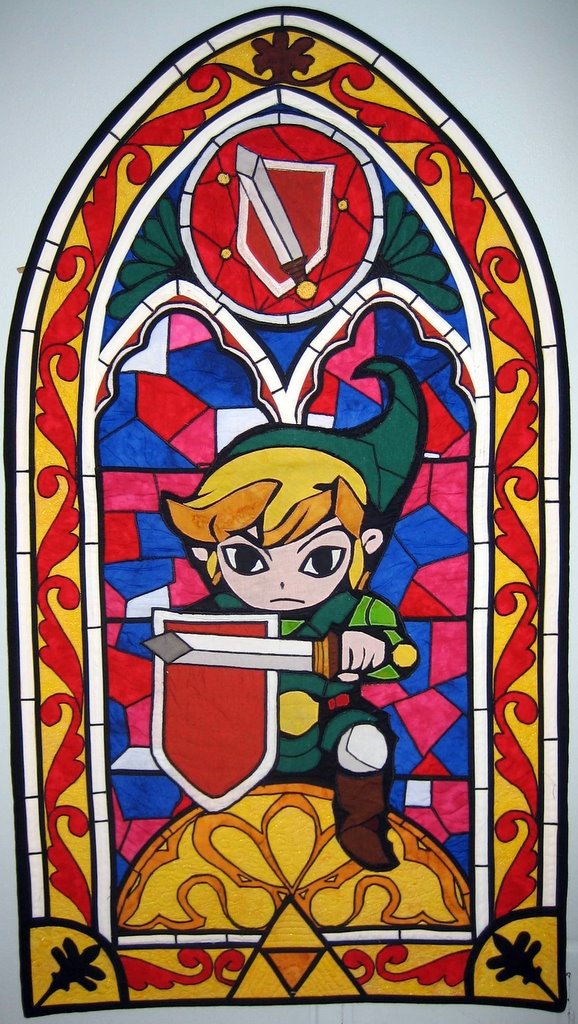
This is the wall hanging I commissioned from my mother. It's based on this Wind Waker promotional desktop wallpaper with some modifications for material and sanity (Link's shield is obviously more detailed in the drawn version.) I was inspired both by the "best gaming tattoo ever" and previous quilts that my mom made.

The quilt took several months to finish and uses several different techniques. On my end the hardest part of the process was creating a black and white image with simplified design elements. After that I created several different colour schemes (some with the intention of making the quilt "easier" to make) and eventually settled on one that was similar to the original design. The black and white outline was then transferred to an overhead transparency and enlarged. From there the pieces were made while I played the waiting game and received tantalizing email updates somewhat akin to a reverse ransom demand as I saw bits and pieces of Link come together rather than fall apart. I'd love to go into more detail about the construction of the piece, but I was only present for the final bits so I'm not entirely certain on the process.
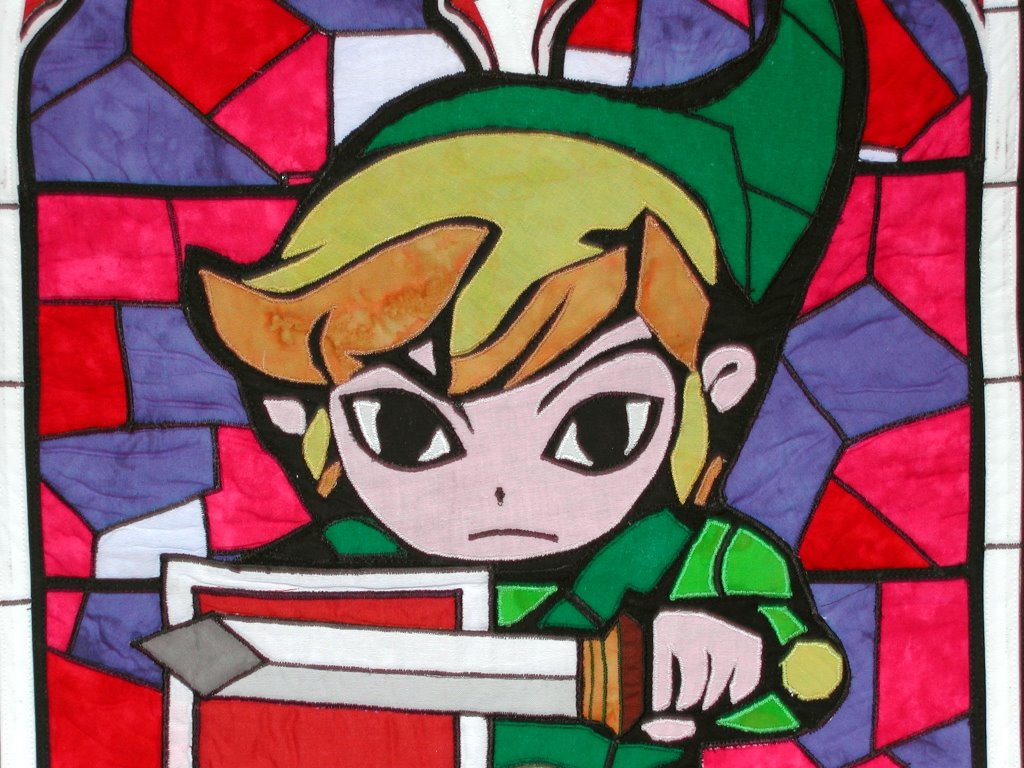
There are five more "stained glass" desktop images on the Wind Waker website (most of them are dead links, pardon the pun, but the images can be found elsewhere on the web) but I have no plans of asking my mom to finish up the set. I think I might find myself having to pay, one way or the other, if I did that. For now I am content to have the one quilt hanging in my livingroom.
Click the right-hand image for a detail shot of Link.
What the Hell Nintendo?
You've done it again. "Wii Prove our Promise" and reveal nothing but a pair of new games. Sure there are a hell of a lot of playable games in Leipzig, but it kind of seems like you might be running short on time. We want a release date.
We (and by that I really mean you, Nintendo) need a release date. We need it to place pre-orders and to start setting aside money that might otherwise go towards other things (games on other platforms etc.) Without a release date many retailers won't take money down, or at least won't be very honest about it. Don't do it for me, do it for yourselves and keep the buzz going.
September 14th is your next and possibly last chance. Don't screw it up.
We (and by that I really mean you, Nintendo) need a release date. We need it to place pre-orders and to start setting aside money that might otherwise go towards other things (games on other platforms etc.) Without a release date many retailers won't take money down, or at least won't be very honest about it. Don't do it for me, do it for yourselves and keep the buzz going.
September 14th is your next and possibly last chance. Don't screw it up.
Thursday, July 27, 2006
History Lesson?
I'll admit, I'm not the world's biggest Sony supporter. In fact I've been a detractor since about the time the PS2 killed off the Dreamcast simply by existing some point in the nebulous future.
The DC had a good year or more lead time in all of the major regions, it was reasonably priced ($199,) and had arguably the best launch library of any console then or since (Soul Calibur, Sonic Adventure, Power Stone etc..) Everything was going the right way for Sega and new and exciting titles were released monthly, but by early 2001 the Dreamcast was officially discontinued.
What went wrong?
The answer isn't surprising, many of you know it already. The Sony hype machine kicked in.
The DC had a good year or more lead time in all of the major regions, it was reasonably priced ($199,) and had arguably the best launch library of any console then or since (Soul Calibur, Sonic Adventure, Power Stone etc..) Everything was going the right way for Sega and new and exciting titles were released monthly, but by early 2001 the Dreamcast was officially discontinued.
What went wrong?
The answer isn't surprising, many of you know it already. The Sony hype machine kicked in.
In April of 1999, month's before the September 9th release of the Dreamcast, Sony began to promote the upcoming PlayStation 2. In the lead-up to its launch the PS2 was presented as a digital entertainment savior who's "emotion engine" was capable of rendering Toy Story in real-time, and referred to as a computer rather than as a console. Much was made of the storage capacity of the PS2's DVD media versus the DC's proprietary GD-ROM.
Despite all of Sony's hype the Dreamcast was superior to the PlayStation 2 (at least when comparing first and second generation games.) The DC cost about half as much, had more quality titles in its initial library, and came ready for on-line gaming. Sega fell to the Sony hype machine.
In reality Sony was little more than the straw that broke the Sega camel's back. The Dreamcast was the first relatively successful piece of hardware in a long line of flops that started with the Sega CD. In addition to financial losses from poor console and add-on sales Sega also lost a good deal of consumer confidence and brand loyalty, which ultimately lead to fewer sales of the Dreamcast.
So, what does this tell us about the fervor? Not as much as we'd like to think. While Sony again finds itself coming second to the market, they are facing a much stronger foe. While the original Xbox Microsoft established themselves as a major player in the business who is willing to do just about whatever it takes to be successful. For once Sony has to take on a company that is as big or bigger than they are.
What can Sony do to win or at least do well in the upcoming console war? Crank the hype machine up to 11. Not the "Riiiiiddddge Raaacer!" or "Giant Enemy Crab" type hype we saw at E3, but real hype. Tout the capabilities of the system, show off some real gameplay footage, nail down some actual exciting exclusives, drop the freaking motion-sensitive controller like a brick.
Sony's problem is that they started the hype too early. We heard about the supposed power of the Cell Processor so many years ago and it has changed so much that we just don't care anymore. The specs and capabilities of the PS3 have varied so much (it was supposed to be a hub, and output to two TV's simultaneously) that each new announcement seemed to elicit disappointment rather than excitement. The price point doesn't help much either.
All in all Sony has to convince us that the PlayStation 3 is a product that we simply must have, at least until we get it into our hot little hands.
Tuesday, July 25, 2006
Exclusively Multi-platform
With today's confirmation that Ubisoft's much-anticipated Assassin's Creed will appear on both Playstation 3 and Xbox 360, it looks like exclusivity is largely a thing of the past. There are a few exceptions, but with perennial exclusives like Rockstar's Grand Theft Auto series moving towards multi-platform support, the general rule of thumb seems to be "if it runs on both platforms, it'll be released on both platforms". Once fanboy favoritism is put aside, this is definitely a good thing for gamers. We're used to being fought over like a kid in a bitter child custody battle, but it looks like we'll finally get the love we so richly deserve no matter which side we choose. How this'll change the dynamics of the console wars, we'll have to see. One thing is certain: it's definitely going to be an interesting generation.
Subscribe to:
Posts (Atom)